
Shady Affiliate Practices
Prefer to watch the video instead of reading this? Go here.
ClickRoamer.com and Tube Wealth SJV| Consumer Protection for Beginners
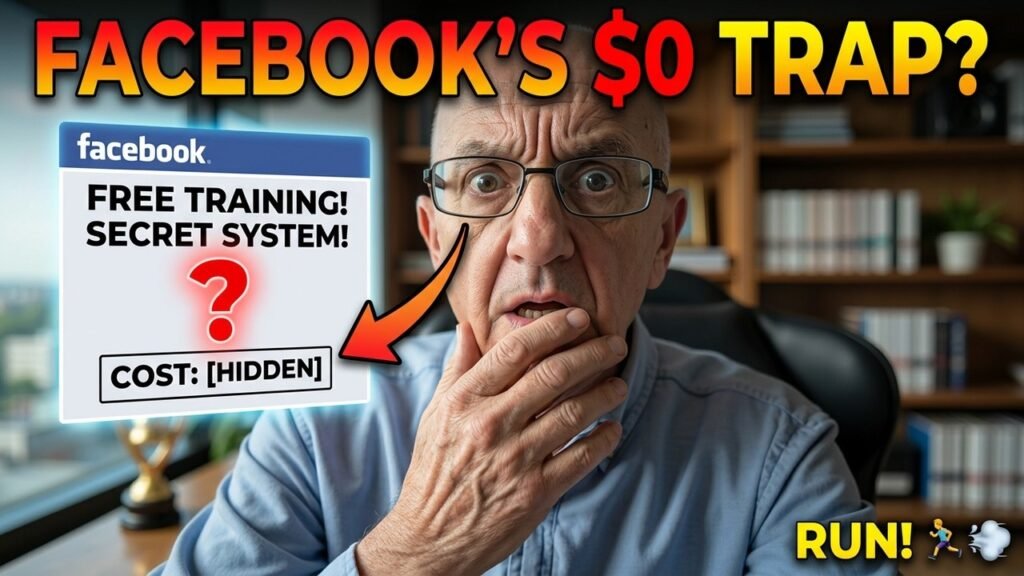
If you have ever been scrolling through Facebook and spotted an ad that promised free training, a secret system, or a revolutionary method for making money online — but never once mentioned what it actually costs — you are not alone, and you are not imagining things.
The price is hidden on purpose.
That is not an accident or an oversight. It is a deliberate sales tactic that has become the standard playbook for a huge chunk of the online product launch industry. And in this article, we are going to pull it apart completely — so that next time one of these ads shows up in your feed, you will know exactly what you are looking at before you hand over your email address, let alone your credit card details.
We will look at how the “free training” funnel actually works, why Facebook keeps allowing these ads to run, what the law says about it, and — most importantly — how to protect yourself as a consumer with a limited budget who cannot afford to be taken for a ride.
What “Free Training” Usually Really Means
Let us start at the beginning.
You are on Facebook. An ad appears. It might say something like:
“Free masterclass reveals how to build a passive income system using AI — watch now!”
Or maybe:
“Join our free training and discover the secret to selling online 24/7 without going live.”
No price. No product name. Sometimes not even a company name you would recognise. Just a promise of something free, and a button that says “Learn More” or “Register Now.”
So you click. You are taken to a landing page that asks for your name and email address. You sign up. You watch a video — or you are told a video is “starting soon” — and somewhere in the middle of that video, or at the end, the pitch arrives. There is a product. There is a price. And depending on how aggressive the funnel is, there might be a countdown timer, a warning that the price goes up in the next ten minutes, or a string of testimonials from people who apparently made life-changing money by buying whatever is being sold.
That whole process — from the Facebook ad all the way to the sales pitch — is called a webinar funnel or a video sales letter funnel. It is a standard marketing mechanism and, in itself, it is not automatically illegal or even unusual. Legitimate businesses use webinar funnels too.
The problem is what happens inside them, and who is using them.
The “No Price in the Ad” Trick — And Why It Works
Here is why online marketers deliberately leave the price out of their Facebook ads.
First, there is a practical reason. Facebook’s ad auction system rewards engagement. The more people click on an ad, the cheaper the clicks become. If you put a price in the ad — say, “$497” — a large chunk of your target audience will immediately scroll past without clicking, because the number triggers a decision before they have had a chance to be persuaded. By leaving the price out, the advertiser gets more clicks at a lower cost per click. That is better for their numbers, at least on paper.
But the more important reason is psychological. The funnel is designed to build desire before revealing cost. By the time you get to the price, the marketer has spent twenty, thirty, or sixty minutes telling you about all the problems you have, why every other solution you have tried has failed, why this one is different, and why the only logical step is to buy. That sequence — problem, empathy, solution, proof, offer — is engineered to lower your resistance to the price, whatever it turns out to be.
That is not necessarily dishonest on its own. But when the ad that started the whole journey made no mention of the fact you were being led into a sales pitch, and when the “free training” turns out to be an extended advertisement for a product you did not know existed, many people rightly feel misled.
And when the product costs $497, or $997, or requires a monthly subscription often charged one year upfront for a slightly reduced price that was not disclosed anywhere in the ad — that feeling of being misled is well founded.
What Facebook’s Own Rules Actually Say
Here is where things get interesting — and frankly, a bit uncomfortable for Meta.
Facebook’s advertising policies, officially called the Meta Advertising Standards, state clearly that ads must not promote products or services using deceptive or misleading practices. According to Meta’s own transparency centre, ads must not promote products, services, schemes or offers using identified deceptive or misleading practices, including those meant to scam people out of money or personal information.
That sounds firm. But there is a significant gap between what the rules say and how they are enforced.
In 2025, Meta reported removing over 159 million scam ads globally, with 92% taken down before users reported them. That sounds impressive until you consider what else the data shows.
A lawsuit filed by the Consumer Federation of America alleges that Facebook users are exposed to approximately 15 billion “likely” scam advertisements daily, generating an estimated $7 billion in annualised revenue for Meta. I know this because I have seen a few FB ads that my security software blocked as a phishing site?
Read that number again. Fifteen billion likely scam ads per day. Even if that figure is contested, the scale of the problem being alleged should concern anyone who uses the platform.
The lawsuit further claims that of approximately 100,000 valid fraud reports submitted by users each week, 96% are either ignored or incorrectly rejected.
The complaint also cites Reuters reporting on a 2025 internal document that appeared to restrict Meta’s enforcement teams from taking measures that could reduce company revenue by more than 0.15%.
In other words, according to the lawsuit, there is an internal revenue protection threshold built into the enforcement process. Scam ads stay up as long as removing them would hurt the bottom line beyond a certain point.
Meta has denied these allegations. The company says it continues to improve its detection and enforcement methods and has developed a multi-layered approach to combating fraud, including using automated technical defences, disrupting criminal scam networks, and strengthening cross-industry partnerships.
But the fact that a major nonprofit had enough evidence to file a lawsuit — and that internal documents appear to back up the core allegations — tells you something important about the environment your Facebook feed exists in.
The Online Product Launch Playbook — Step by Step
Let us go even deeper, because understanding the mechanics makes these things much easier to spot.
The online product launch industry has been using a fairly consistent playbook for years. It goes something like this:
Step 1: Identify a hungry audience. Usually people who want to make money online, build a business, lose weight, find a relationship, or solve some other emotionally charged problem. People with limited budgets and a genuine desire to improve their situation are particularly targeted, because they are actively searching for solutions.
Step 2: Run a Facebook ad promising free value. The ad uses curiosity, urgency, or a bold claim to get a click. No price. Sometimes no product name. Sometimes no brand name either — just a face, a promise, and a button.
Step 3: Capture the email address. The “free training” registration page collects your contact details. Whether you buy anything or not, the marketer now has your email address and can continue marketing to you indefinitely. A few continue even after you unsubscribe?
Step 4: Deliver the “training.” This might be a live webinar, a pre-recorded video dressed up to look live, or an automated presentation that runs every twenty minutes around the clock. The content usually contains a mixture of genuine information and carefully structured sales psychology. The goal is to build rapport, establish credibility, identify your pain points, and present the product as the only logical solution.
Step 5: Make the pitch. Usually at the sixty to eighty percent mark of the presentation, the offer appears. This is where you find out what you are actually being sold and what it costs. By this point, you have invested time, you have been built up emotionally, and the price has been pre-framed by comparisons to much higher figures — “I could charge $20,000 or $10,000 for this, but today only you can get it for just $497.”
Step 6: Apply pressure. Countdown timers. “This price goes away when you leave this page.” Bonus stacks that disappear at midnight. Limited spots. All designed to prevent you from doing the one thing that could protect you: going away and thinking about it.
Step 7: Upsells. You buy the main product. You are immediately presented with an “upgrade” or a “one-time offer” — often something that should have been part of the original package. Then another one. In some funnels, there are four, five or six upsell screens before you reach your account.
Step 8: Automate and repeat. The webinar runs automatically, twenty-four hours a day, sending the same pitch to a continuous stream of new people who clicked the same Facebook ad. The person who made it might run dozens of these funnels simultaneously across different products and niches.
Does this describe every online marketer on Facebook? No. There are people using webinar funnels to sell genuinely useful products at fair prices with transparent terms. But it does describe a very large proportion of what you will encounter when you click on a “free training” ad in the make-money-online or digital marketing space.
The Specific Tactics That Should Make You Stop and Think
Over the years, I have looked at a lot of these products and funnels. Here are the specific patterns that should immediately raise your guard.
1. No price anywhere in the ad or on the registration page.
A legitimate business is not embarrassed by its pricing. If you cannot find out what something costs without giving your email address, that is a deliberate barrier designed to keep you in the funnel. It is not a mystery. It is a tactic.
2. “Free training” that is really a sales pitch.
There is nothing wrong with offering a free webinar that also sells something. But if the training is essentially an extended advertisement with a thin layer of content wrapped around it, you are not being educated — you are being sold to under the cover of education.
3. Artificial urgency and scarcity.
“Only 3 spots left.” “Price doubles at midnight.” “This page will be gone tomorrow.” If you close the page and come back an hour later and the countdown has reset — which it often has — the scarcity was fake. That is a deceptive practice, full stop.
4. Testimonials with no verifiable details.
“John from Texas made $47,000 in his first month.” No surname. No business name. No way to verify anything. Testimonials like this are almost meaningless as evidence. They may be cherry-picked best cases, or in some situations, fabricated entirely.
5. Hidden upsells.
The price you see in the ad — when a price is shown at all — is often the entry-level product in a funnel designed to extract significantly more money. Some products advertise a one-time fee of $7, or $17 then present four additional “upgrades” that cost $97, $197, $297, and $497 or more. The full cost of getting the “complete” product is never disclosed upfront.
6. “No negative language” affiliate clauses.
This one is less visible to consumers but worth knowing about. Many of these products recruit affiliate marketers to promote them, but include contractual clauses forbidding affiliates from publishing anything negative about the product — even honest critical reviews. That means the review landscape for these products is artificially skewed toward positivity, because anyone who tried to write a balanced review was legally barred from doing so.
7. Billing surprises.
Some products offered at a one-time price turn out to have ongoing subscription components buried in the terms. Others charge annual renewal fees without sending a reminder. One user reviewing a popular webinar platform reported being charged $543 every April for three consecutive years with no advance notice and no receipt — and was told the company does not issue refunds on recurring subscriptions regardless of usage. That pattern — charging silently and refusing refunds — is not uncommon in the online marketing software space.
Why Facebook Keeps Running These Ads
The simple answer is money.
According to the Federal Trade Commission, in 2025, nearly 30% of people who reported losing money to a scam said it started on social media, with reported losses reaching $2.1 billion. People reported losing more money to scams that started on Facebook than on any other social media platform.
Facebook’s advertising revenue is enormous, and a significant portion of it comes from the online marketing space. Tightening ad standards aggressively enough to eliminate manipulative product launch funnels would cost Meta a substantial amount of that revenue.
Consumer affairs researchers and advertising watchdogs have noted that the sketchiest ads are not always obvious scams — many look polished, emotional, and “too legit to question,” right up until you read the fine print — or realise the fine print was the whole trick.
The enforcement challenge is also genuine. Meta processes millions of ads. Distinguishing between a legitimate webinar funnel and a predatory one requires human judgement calls that automated systems struggle to make reliably. An ad that says “free training” and links to a registration page is not inherently in violation of ad policies — even if the funnel behind it uses every psychological pressure tactic in the book.
But that does not absolve the platform of responsibility. When internal documents suggest that enforcement teams are constrained from acting if the cost to revenue is too high, that is not a technology problem. That is a business model problem.
What the Consumer Protection Regulators Say
The regulatory picture is uneven but moving in the right direction.
In the United States, the Federal Trade Commission has guidelines that require advertisers to clearly and conspicuously disclose material information — including price — before a consumer makes a purchasing decision. Deliberately concealing the cost of a product until after a significant emotional investment has been made sits in uncomfortable territory under those guidelines.
The FTC has also been clear that testimonials must reflect typical results rather than exceptional cases, and that fake urgency and scarcity claims — countdowns that reset, “limited spots” that never run out — are deceptive practices.
In the United Kingdom, the Advertising Standards Authority and the Competition and Markets Authority have similar frameworks. Hidden pricing, pressure selling, and misleading claims about scarcity or exclusivity are all areas where enforcement action has been taken.
False advertising is not going away — in fact, it is only getting more sophisticated, especially online and on social media. But knowing how to spot misleading advertising gives you power as a consumer.
The challenge is that regulatory bodies are slow, and the online product launch world moves fast. By the time a complaint is investigated and action is taken, the product, the brand name, and sometimes even the company behind it have changed. The same people launch new products under new names, run the same funnel playbook, and start again.
The Specific Case That Triggered This Article
This article was partly prompted by an ad I spotted on Facebook for a product called WebinarKit, promoted via the URL getwebinarkit.com/training. The ad promised free training on building an automated webinar sales system. No price in the ad. No mention of what was being sold or how much it cost.
When you dig into WebinarKit as a product, you find that it is a real, functional webinar platform — not a fake product or an outright fraud. But you also find a documented pattern of billing practices that multiple real users have complained about publicly: annual renewal charges with no advance notice, no post-charge receipt, and a refusal to issue refunds even on accounts that were never used.
One reviewer described being charged the equivalent of hundreds of pounds every year for four years on a subscription they had stopped using, with no warning before each charge and no recourse when they complained. Another described being unable to log in at all after paying for an annual subscription.
The “no negative language” clause in their affiliate programme means that the majority of reviews you will find online are written by affiliates who are contractually prevented from being critical. That is not a small detail — it fundamentally distorts the information environment a potential buyer is navigating.
None of this makes WebinarKit a scam in the classic sense. But it does make it a product that a careful consumer, with a limited budget, should approach with significant caution — and should certainly research thoroughly before handing over payment details.
The fact that the Facebook ad hid the price and framed the whole thing as free training is the detail that concerns me most. Because that framing is specifically designed to get someone into the funnel before they have had the chance to do that research.
How to Protect Yourself: A Practical Checklist
Here is what I recommend doing every time you encounter a “free training” or product launch ad on Facebook — before you click, before you register, and before you even think about buying.
Before you click:
- Search for the product name or the company name combined with the words “review,” “complaints,” or “refund.” Do this in a separate browser tab before you register for anything.
- Look at who is running the ad. Go to Meta’s Ad Library (adslibrary.com) and search for the advertiser. You can see all the ads they are currently running. If they have dozens of variations of the same ad targeting different audiences, that is a sign of a high-volume commercial operation rather than someone sharing genuine knowledge.
- Note whether the ad discloses any price or product name. If it does not, ask yourself why.
After you register but before you watch:
- Search for reviews on independent platforms — not affiliate review sites. Look at Trustpilot, G2, and Reddit. Search specifically for complaints.
- Check whether the affiliate programme for this product has a “no negative language” clause. This is often buried in the affiliate terms page.
- Look for information about the refund policy before you commit any time to watching a pitch.
If you decide to buy:
- Screenshot or save a copy of the pricing page before completing the transaction.
- Read the full terms and conditions, specifically looking for recurring billing, subscription components, and renewal clauses.
- Pay by credit card where possible. Credit cards offer consumer protection that debit cards and payment apps typically do not.
- Set a calendar reminder for 30, 60, and 90 days after purchase to check whether any recurring charges have appeared on your statement.
- If there is a refund window, decide whether the product is working for you before it closes — and note the expiry date.
If things go wrong:
- Document everything. Screenshots, emails, transaction records.
- Contact your bank or card issuer if you believe a charge was made without adequate disclosure of recurring billing terms.
- Report misleading ads to the platform directly, and report fraudulent or deceptive practices to the FTC (in the US) at ReportFraud.ftc.gov, or to the ASA or Citizens Advice (in the UK).
- Leave an honest review on Trustpilot or G2. Other consumers rely on those reviews to make decisions, and your experience — good or bad — is genuinely valuable information.
Should Facebook Do More?
Yes. Without question.
The argument that Meta cannot police the quality of every ad it runs does not hold up when you look at the scale of the enforcement capacity that exists, the evidence that revenue considerations have limited enforcement activity, and the sheer number of people losing money to social media scams every year.
The FTC reports that social media scam losses have increased eightfold since 2020, reaching $2.1 billion in 2025 alone.
A platform that reaches billions of people daily and generates hundreds of billions in revenue can afford to enforce its own advertising standards more aggressively. The technology exists. The policy framework exists. What appears to be lacking is the commercial will to apply them consistently when doing so would cost advertising revenue.
That is a choice, not a limitation.
It is also worth noting that the stricter regulators become in some markets, the more advertisers shift their tactics slightly to stay within the letter of the rules while violating their spirit. A funnel that hides its price is not necessarily technically illegal. A countdown timer that resets is arguably misleading but hard to prosecute. The gap between “legal” and “ethical” is enormous in the online marketing space, and platforms like Facebook currently sit comfortably in that gap.
Until that changes — through tighter regulation, better enforcement, or meaningful platform accountability — the burden of protection falls on the individual consumer. That is not fair. But it is the reality we are working with.
What Honest Online Marketing Looks Like
It is worth saying clearly: not everything in the online marketing world is designed to deceive you. There are genuine products, honest marketers, and real value available — even for people with limited budgets.
Honest online marketing tends to look like this:
- The price is disclosed clearly and early, ideally on the sales page, before you have to commit significant time or emotional energy to a pitch.
- The refund policy is clear, written in plain language, and actually honoured.
- Testimonials come with verifiable details, and the results described are presented as examples rather than typical outcomes.
- Affiliates are allowed to publish honest, balanced reviews — including criticisms.
- Renewal charges are communicated in advance with enough notice for you to make a decision.
- The product does what it says it does.
These are not high standards. They are the baseline standards that any reputable business in any other industry would be expected to meet. The fact that so many online product launches fall short of them is not because the standards are unreasonable. It is because a culture of aggressive sales tactics has become normalised in this space, and platforms like Facebook have not enforced the rules that would change that culture.
Final Thoughts
If you take one thing from this article, let it be this: the moment you see a Facebook ad that promises free training without disclosing what the training is about, who is selling it, or what the eventual additional costs will be — slow down.
That format is not accidental. It is the first move in a carefully constructed sequence designed to get you emotionally invested before your analytical brain gets a chance to weigh in.
That does not mean every product at the end of that funnel is worthless. Some of them are fine. But the decision to hide the price, manufacture urgency, and frame a commercial pitch as free education is a decision that puts the seller’s interests ahead of yours from the very first second.
And if a product cannot be sold honestly — with a transparent price, a fair refund policy, and reviews that affiliates are allowed to write honestly — then that product usually does not deserve your money.
The online marketing industry has a long way to go before it deserves the trust of the people it is trying to reach. Until it gets there, the best protection you have is information. Which is exactly what this channel is here to give you.
Found this useful? Subscribe to ClickRoamer.com and the TubeWealthSJV YouTube channel for honest, no-hype reviews and consumer protection content for beginners in affiliate marketing. And if you have had an experience with a misleading Facebook ad or a product funnel that did not deliver what it promised — share it in the comments. Your story might save someone else a lot of money.
Word count: approximately 3,800 words | Estimated reading/viewing time: 14–16 minutes
Primary SEO keyword: why do Some Facebook ads hide the price
Secondary keywords: Facebook ad hidden price online marketing, free training Facebook ad scam, how online product launches work, deceptive Facebook ads, webinar funnel tactics